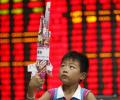
China now world's second largest share market, India is 7th

Chances of a sudden collapse in the Shanghai Composite are remote.

Once tipped to emerge as the biggest exporter, the pharmaceutical industry is yet to acquire the scale of those in software services, says Krishna Kant.

There, however, has been an improvement in operating margins.
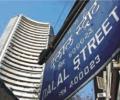
Through the past 12 months, the Bank Nifty has risen 55%

The benchmark Sensex companies' underlying earnings per share are down 3 per cent (on a cumulative basis) since January 2015, against 25 per cent rise in the index value during the period

Flipkart will need $2 bn annual profit to make Walmart investment viable, which will mean yearly revenue of $100 bn

This weakness is likely to continue in the near-term.
With mutual funds, promoters turning net-buyers, foreign investors may have to bid up prices to raise holdings.
Tata Steel and Tata Chemicals under investor watch

Companies in the small-cap universe are having a dream run - the Nifty Smallcap 100 index has shot up more than 25 per cent on a year-to-date basis, even as the benchmark Nifty is up 7 per cent. This is the best start for the index since 2017 when the Nifty Smallcap 100 index surged 32.3 per cent between January 1 and May 10. However, in terms of outperformance to the Nifty, this year's performance is the best in more than a decade. A combination of sectoral tailwinds and lack of institutional selling pressure has helped small companies escape from the correction triggered by the second wave of Covid-19.
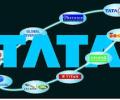
Leverage ratio falls to under 1; but group heavily dependent on TCS & Tata Motors.

The gap between Nifty's price-earnings multiple and economic growth is at a 12-year high

ICICI Bank was the top gainer after stable rating for its senior unsecured bonds by S&P Global Ratings.

Pharma shares extended losses after the government's ban on combination drugs.
The BSE Sensex and Nifty fell more than 2 per cent on Tuesday, heading for their biggest daily loss since the midst of the rupee crisis in 2013

Wonder why corporate India is showering dividends?

Growth concerns on China, which has already seen the yuan getting devalued twice in August, have rattled global financial markets, including that of India.
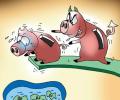
Premium valuations era started in 2006 and went hand in hand with decline in the US interest rates

Experts say the BSE Sensex could rise to around 32,000 in a year.

Sensex, Nifty put up a good show in closing trade.
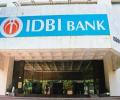
The buyout will cost LIC about Rs 100 billion, based on the Rs 248 billion market capitalisation of IDBI Bank as on Friday, and assuming it acquires a 40 per cent equity stake from the government.


Sales expansion also down 4.4%

23 Nifty companies reported an annual decline in net profit.
Total net debt-equity ratio improves for third consecutive year, while investment in new projects hits a 10-year low, says Krishna Kant.

Corporate indebtedness is now twice what it was before the global financial crisis; banks' bad loans ratio is 3.5 times higher.

What worked for the markets was favourable global investor sentiment and encouraging flows into the emerging markets following stimulus measures taken by central banks.

That resulted in a 50-basis point improvement in operating profit margins on a sequential basis.

IT exporters were the top gainers amid a weak rupee along with select index heavyweights.

Players like UltraTech Cement more expensive than ITC and HUL; others catching up fast.

If financials and oil sectors were removed, India Inc has done quite well.

The S&P BSE Sensex plunged 301 points to close at 25,490 and the Nifty50 fell 86 points to end at 7,815.
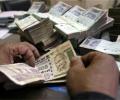
IT companies account for a third of the entire dividend pot this year

The company plans to overhaul business and rationalise costs in a bid to reach parent Unilever's new profit targets, reports Viveat Susan Pinto.

Eight Sensex biggies such as Reliance, L&T, BHEL, SBI and ICICI Bank are among the worst hit.

The relentless rally in small- and mid-cap stocks continues as large-caps show signs of fatigue. In July, the Nifty Smallcap 100 rose 8.1 per cent, extending its year-to-date (YTD) gains to 48.5 per cent, while the Nifty Midcap 100 added 3.1 per cent, taking its YTD rise to 33.5 per cent. On the other hand, the Nifty50 remained unchanged for the month, with YTD gains of 12.7 per cent.

From MRF to Shree Cement: 23 companies which delivered 30% CAGR in 15 years.

The Sensex ended lower on unfavourable cues.
Bharti Airtel, HDFC, ONGC, ITC and CIL emerged as the top gainers.
